

Defining Pre-Execution Privacy
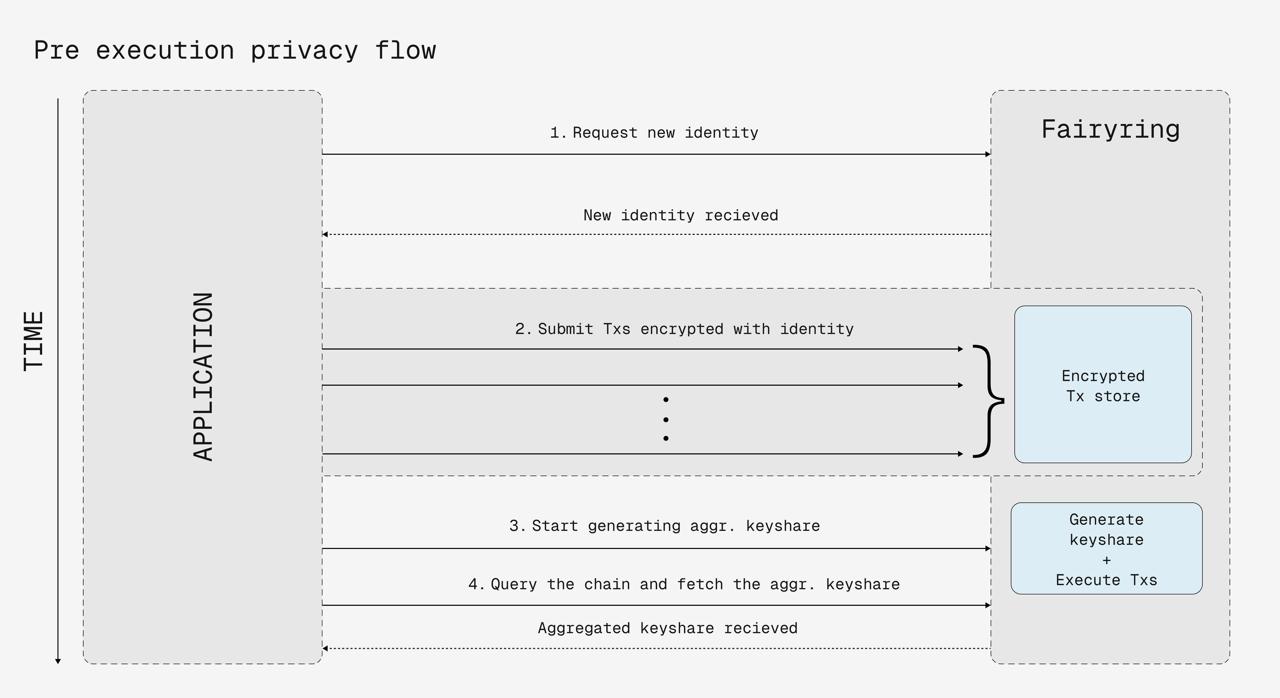
Transactions are encrypted under a public key and only decrypt once a specified condition is met; a block height, a price trigger, a proof, or an auction close. When the condition fires, a decentralized validator set derives the decryption key and the transaction is decrypted and executed at the start of the block, before anyone can react to it. This combination lets you:- Protect orders, bids, and votes from frontrunning and manipulation
- Get deterministic, fair ordering without a trusted operator
- Selectively disclose only what’s needed, only when it’s required
Core Applications
Sealed-Bid Auctions
Sealed-Bid Auctions
- Encrypted bids that stay hidden until the auction closes
- One fair clearing outcome, with no privileged party able to peek or leak bids
DeFi & Trading
DeFi & Trading
- Encrypted orderflow, limit orders, and intents resistant to frontrunning and sandwiching
- Fair price discovery for trading and lending markets
Governance
Governance
- Private voting where ballots stay encrypted until the vote closes
- Removes vote-buying and last-minute strategic voting
Access Control & Selective Disclosure
Access Control & Selective Disclosure
- Encrypt data so only a specific party or group can decrypt it
- Reveal a specific transaction, and only that one, when required
Why Fairblock
No trusted decryptor
Decryption keys are generated by a decentralized validator set using threshold cryptography (MPC-IBE). There is no single sequencer, operator, or key holder that can peek at, leak, or censor encrypted transactions.
Lightweight and fast
The cryptography is light enough to run inside a normal transaction flow. There are no multi-minute proofs and no dependence on heavyweight offchain computation, so pre-execution privacy stays practical for real trading, auctions, and settlement.
No black-box trust
Correctness is verified onchain. Fairblock intentionally avoids single-TEE setups, outsourced provers, and centralized offchain coprocessors, minimizing trust assumptions and security risk.
Confidentiality where liquidity already lives
Pre-execution privacy is available across the ecosystems you already use, including EVMs and Cosmos chains, so you keep your existing wallets, liquidity, and workflows without bridging into an isolated privacy chain.
Next Steps
Architecture
Understand the MPC-IBE design powering pre-execution privacy.
Quick Start
Run your first confidential app on FairyRing or an EVM.