Public Keys
Users encrypt their transactions using a master public key (MPK) and then choose the condition for decryption (the ID).fairyring maintains at most two MPKs at any given time: an ActivePubKey and a QueuedPubKey.
Both kinds of MPKs are submitted to the network with expiry block heights. These expiry block heights mark the end of epochs.
The ActivePubKey is the one currently being used for encrypting transactions.
The QueuedPubKey, as the name suggests, is an MPK that will replace the ActivePubKey once the current ActivePubKey expires.
Active and Queued MPKs are generated and replaced at the end of epochs, which are encoded block heights for MPK generation and renewal.
Encrypting Transactions
Unlike normal transactions, encrypted transactions work a bit differently. Users can encrypt any transaction with the currentActivePubKey.
The user must also specify the target block height of fairyring (condition) at which the transaction is to be executed on the chain the transaction resides on.
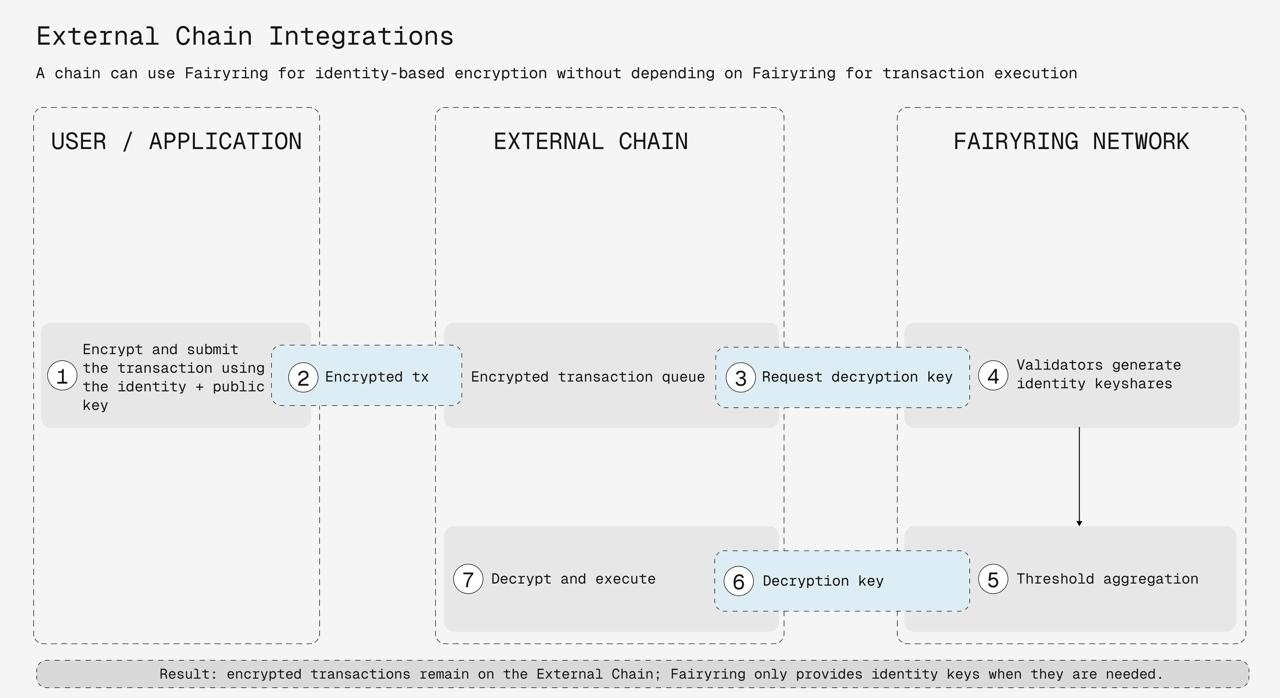
The submitted encrypted transaction then resides in the x/pep module of the destination chain.
For more details, refer to this tutorial.
Keyshares and Aggregation
Keyshares
Each MPK is derived from a Master Secret Key (MSK), which is generated each epoch by the Share Generation Client. Once the MSK is generated, the Share Generation Client then performs a function to- Derive the MPK
- Splits up the MSK into individual keyshares encrypted by each validator’s public key
- Submits the encrypted keyshares along with the MPK to
fairyring - Discards the full MSK.
fairyringclient
to derive the private keyshare for each block height corresponding to the ActivePubKey.
After the private keyshare is generated, the validator submits it via a transaction to fairyring.
fairyring aggregates the private keyshares, and when the threshold for private key construction is met, derives the private key for the current block height.
Each validator needs to run the fairyringclient in order to receive their MSK share each time it changes,
derive their private keyshare according to the ActivePubKey for each condition,
and then submit the private keyshare to fairyring for private key construction.
The initial release will be a Proof of Authority (PoA) chain similar to the approach used by Noble.
There are some simple slashing conditions implemented for now (such as submitting incorrect keyshares, or skipping blocks), but this may change.
Keyshare Aggregation
The key share aggregation process is made possible through threshold cryptography. Once enough validators have submitted keyshares for a particular block, the keyshares are aggregated to generate the derived private key for that block. The derived private key can then be used to decrypt all encrypted transactions under a certain condition and execute them. To create the aggregated keyshare, it is not required for every validator to submit their individual keyshares. The aggregation can be performed as long as a threshold number of keyshares are submitted. Currently, at least2/3 + 1 of the validators have to submit keyshares to create the aggregated keyshare.
Transaction Decryption and Execution
Upon reaching the target height, the transaction is decrypted using the derived private key of the particular block height and executed before any of the mempool transactions for that block can be processed. The derived private key for target block heights is sent to the destination chain viaFairyPort,
a messaging bridge developed by the Fairblock team that reads the state of the destination chain and fairyring to communicate to
fairyring when conditions for decryption are met on the destination chain.
When fairyring is notified that the decryption conditions have been met,
the validators compute their derived private key shares and submit them to fairyring for key share aggregation.
When the threshold is met, fairyring constructs the derived private key, emits a state change with the derived private key in the state,
and then FairyPort sends the private key to the destination chain after observing the FairyRing state change.
Once the destination chain has access to the derived private key, it decrypts the encrypted transaction in the mempool and executes it.
 Note the following things:
- encrypted transactions are stored in the
x/pepof their corresponding chains. They are not transferred over IBC tofairyring. - encrypted transactions are executed in their corresponding chains (not
fairyring). - the target height for executing an encrypted transaction corresponds to the height on
fairyring. Decryption triggered by another chain’s conditions is live for private governance, while alternative conditions for decryption on destination chains will soon be implemented. - interactions between
fairyringand Cosmos chains will work differently than non-Cosmos chains. We will share information regarding non-Cosmos chains soon.